

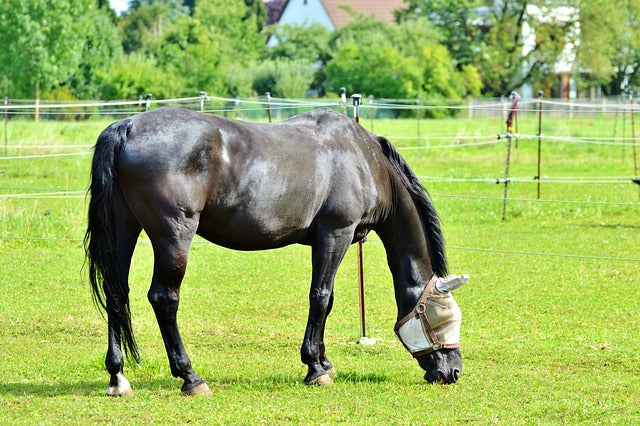
How to protect your horse from annoying horseflies
You're in the stable or pasture, and suddenly your beloved horse is bothered by dangerous horseflies. These blood-sucking pests are active from April and can lay up to 1,000 eggs! Dark horses are particularly affected, as they are targeted up to four times more often than light-colored ones. The horsefly not only has a nasty appearance but also recognizes its victims thanks to its keen sense of smell. Let's explore the best tips together on how to protect your four-legged friends from these bloodthirsty insects!

The horsefly: Feared by all horse lovers
The breeding season
When summertime arrives, horseflies embark on a relentless hunt for horses. The breeding season lasts six to eight months, and during this time, female horseflies can lay up to 1,000 eggs. These tiny vampires are not only blood-sucking but also extremely annoying, causing your beloved horses to be constantly restless and irritated.
The life cycle of the horsefly
The life cycle of the horsefly is a fascinating, yet terrifying, subject. Horseflies go through several developmental stages: egg, larva, pupa, and finally, the adult insect. These insects are mainly active between April and August, seeking warmth and vitality – dark horses, in particular, attract them like a magnet.
To understand the full extent of their horror, you should know that horsefly larvae live in damp, marshy areas and feed on organic waste there. After the eggs hatch, the larvae emerge and overwinter before transforming into pupae the following spring. As adult horseflies, they then hunt for fresh blood, with their preference for dark horses making them even more dangerous. So, if you are a horse lover, you should pay close attention – it's time to prepare for this pesky invasion.
Know your enemy
Physical characteristics
If you want to identify the horsefly, look for its distinctive appearance: it is between 1.9 and 2.5 cm long and has a more elongated, slender appearance compared to a housefly. Its wasp-like gray and brown stripes on its abdomen make it unmistakable. These pests may not be the cutest insects, but their appearance reveals that they are on the hunt for fresh blood.
Behavioral patterns
The horsefly targets a very specific recipient: your horse! Active phases are from April to August, especially when it's warm and humid, which makes them absolutely crazy about your animal friend.
These insects possess extraordinary abilities: they use their highly sensitive antennae to detect chemical substances in your horse's sweat and breath over long distances. This explains why some horses, especially dark-colored ones, often experience these dreaded vampire visits more frequently than their lighter-colored siblings. Yes, you heard right: dark horses are often magnetic to horseflies, which like to settle on warmer, relaxing surfaces while simultaneously trying to avoid the momentum of your horse when it wildly swishes its tail.

How the horsefly finds its prey
Chemical detection
You might be wondering how the horsefly manages to find its victims so precisely? It's a game of chemistry. These little vampires use their sensitive antennae to detect chemical substances in the sweat and breath of their victims. No matter how far away you think you are, the horsefly can sniff you out over long distances. Imagine it as an insect GPS that never fails.
Heat sensing
But that's not all! Horseflies have a special sense for body heat. While you might still be casually strolling across the meadow with your horse, these pests use your body heat as a signal for their next feast. Dark horses, which warm up, attract horseflies even more. Who would have thought that nature could be so merciless?
This is exactly why dark horses are particularly vulnerable. Your brown or black horses heat up faster, which magically attracts horseflies. Scientists have replicated this with experiments on barrels and found that horseflies prefer warm surfaces. So, if you have a dark-colored horse, be warned! These little monsters are fast and can land on your prey in a flash thanks to the heat. All the more reason to keep a close eye on your horse during the hot summer day.
The effect of dark coat color
Current research findings
A Hungarian research team has shown that dark-colored horses are targeted four times more often by horseflies than their lighter-colored counterparts. This study impressively demonstrates how coat color has a decisive influence on horsefly infestation.
Why are dark horses attacked more often than light ones?
Dark horse coats magically attract horseflies, and there are reasons for that. The parasites prefer warm surfaces because their wing muscles and nervous system can develop optimally there. This makes dark-skinned individuals particularly vulnerable.
Researchers experimented with warm barrels to simulate horsefly behavior. It turned out that the parasites not only react to color, but also that the temperature of the surface is significantly more important. A dark horse heats up quickly, which attracts horseflies to do their nasty work there. So, if you have a dark horse, be especially vigilant and protect your four-legged friend with effective means against these annoying bloodsuckers!
Protection for your horse
Use of repellents
To protect your horse from annoying horseflies, repellents are essential. An effective horsefly spray not only offers protection against horseflies but also against flies, mosquitoes, and ticks. With plant-based active ingredients, urea, and aloe vera, your four-legged friend is safely protected from these annoying pests, while their skin is simultaneously cared for. Dress your horse with this additional protection and prevent the pests from completely attacking him.
The HVC Fly Spray for Horses
When it comes to protecting our beloved horses from annoying insects like horseflies, the HVC Fly Spray for Horses is the optimal choice. This effective spray offers natural protection against mosquitoes, ticks, and horseflies, while also caring for your horse's coat and skin. The unique coat protection formula with aloe vera and glycerin soothes and regenerates the skin, provides moisture, and has a cooling effect. Aloe vera is rich in vitamins B and C, folic acid, and carotene, making it an excellent moisturizer, while glycerin optimally nourishes the skin and coat.
Another advantage of the HVC spray is the combination of neem oil, eucalyptus oil, citronella oil, peppermint oil, and tea tree oil. Neem oil is a proven, natural pest control agent that reliably works against a variety of insects. Eucalyptus oil protects against mosquitoes and inhibits the growth of bacteria, while citronella oil has a deodorizing, antiperspirant, and slightly antiseptic effect. Peppermint oil relaxes muscles and clears airways, and tea tree oil has anti-inflammatory, wound-healing, and itch-relieving properties.
Dressing for success
It pays to be strategic when choosing your clothing for rides on warm summer days. Light colors are key to avoiding horseflies, as they are particularly attracted to dark coats. Dark horses are affected four times more often by these pests because they heat up more. So, by opting for lighter clothing, you not only stay chic but also reduce the likelihood of becoming prey to one of nature's nastiest biting insects.
Your own outfit can have a huge impact on dealing with horseflies. Dark tones magically attract these pests, which means that light-colored clothing when riding out is not only stylish but also practical. With a clever wardrobe that includes light colors, you can make not only your horse but also yourself safe. Keep the horseflies at bay and enjoy calm, peaceful rides without your horse constantly swatting at the pests!

Our top tip
Introducing the ultimate horsefly spray
When horseflies become a nuisance, it's high time to act! Our fly spray for horses offers maximum protection against horseflies, flies, mosquitoes, and other *stinging insects*. It is particularly effective in protecting your beloved horses from these annoying bloodsuckers during peak season.
Natural ingredients for maximum protection
You might be wondering what makes our *horsefly spray* so special? It contains plant-based active ingredients that are not only effective but also *gentle on your horse's skin*. In combination with urea and aloe vera, it supports skin health while simultaneously keeping *unwanted guests* away.
The use of natural ingredients is crucial. They not only offer maximum protection against horseflies and other insects but are also *less harmful* to the environment. Urea acts as an excellent moisturizer that nourishes your horse's skin, while aloe vera is known for its soothing properties. This combination not only ensures that your horse is *protected* but also that it feels *comfortable* while in the pasture or stable. Let the pests go and give your horse the comfort it deserves.
Conclusion
The horsefly is not only an annoying companion in summer but also a true vampire that can make life hell for you and your horse. With their striking big eyes and their urge for blood, they are a nuisance that particularly attracts dark horses. So, play it safe and protect your four-legged friends with an effective horsefly spray. After all, you don't want your ride to turn into a bloody nightmare!
These questions about horseflies are frequently asked:
1. What happens if you are bitten by a horsefly?
A horsefly bite is painful because these insects use their sharp mouthparts to penetrate the skin and suck blood. The bite can lead to a painful swelling and redness and often itches intensely. In some cases, allergic reactions may occur, requiring medical treatment.
2. When do horseflies bite humans?
Horseflies usually bite humans on warm, sunny days, especially near water and pastures. They are most active in the summer months when temperatures are high. Horseflies are attracted to movement, sweat, and body heat.
3. What helps against horseflies for humans?
Insect repellents containing DEET or Icaridin help against horseflies. Wearing light-colored, long-sleeved clothing can also prevent bites. After a bite, cold compresses, antihistamines, and special ointments for itching and swelling can provide relief.
4. What attracts horseflies?
Horseflies are attracted to movement, sweat, body heat, and dark clothing. CO₂ emissions and body odor also play a role in attraction. They are particularly active near water and humid areas.
5. What does a horsefly bite look like?
A horsefly bite is often larger and more painful than a mosquito bite. It is characterized by significant redness and swelling and may show a small bleed. The bite itches intensely and can last for several days.
6. What keeps horseflies away?
To keep horseflies away, insect repellents with DEET or Icaridin can be used. Wearing light-colored, long-sleeved clothing also helps. Avoiding staying near water and humid areas during peak season can also be helpful.
Image credits:
Further links:
Editorial guidelines of the Horse Vitality Company
At Horse Vitality Company, we create every contribution according to strict quality standards and rely on reputable sources and scientific research. Our editors are proven experts in the field of equine health and offer you well-founded, trustworthy information.
Expertise and Quality Assurance
- Qualified Authors: Our editors have extensive expertise in horse health and animal care.
- Double Check: Every article is additionally reviewed by a second expert to ensure accuracy and relevance.
Sources and Transparency
- Reputable Sources: We only use trusted sources and scientific studies to substantiate the content.
- Disclosure: We disclose potential conflicts of interest and ensure transparency.
Reader-friendliness and topicality
- Reader-friendly preparation: Our content is continuously optimized to make it as understandable and accessible as possible.
- Timeliness: We regularly review our articles and update them as needed to ensure they are always up-to-date.
Interaction and Feedback
- Reader orientation: Our goal is to provide you with initial guidance. For individual health or care questions, we recommend consulting a veterinarian or animal naturopath.
- Feedback option: We invite our readers to provide feedback and ask questions. Your suggestions help us continuously improve our content and tailor it to your needs.
These guidelines ensure that the content of the Horse Vitality Company always meets the highest standards of expertise, authority, and trustworthiness.


.jpg)
