

The Holsteiner: All About the Oldest German Horse Breed
The Holsteiner horse breed, one of the oldest and most successful German horse breeds worldwide, impresses with its versatility and willingness to perform. From its historical significance as a carriage and working horse to its modern sporting successes in show jumping and dressage, this breed shows remarkable adaptability. With a life expectancy of up to 30 years and no breed-specific diseases, Holsteiners are an excellent choice for both sports and leisure riders.

Profile: Holsteiner
| Origin | Germany |
| Main breeding area | Schleswig-Holstein |
| Distribution | Throughout Europe |
| Bred since | 13th-14th century |
| Life expectancy | 25 - 30 years |
| Height | 160 to 175 cm |
| Weight | 650 - 800 kg |
| Color | Bay, Gray, Chestnut, Black |
| Type | Warmblood |
| Character | Intelligent, willing to perform, patient, sensitive, balanced |
| Body |
Large, powerful build; Long, strong neck and pronounced hindquarters; |
| Suitable for | Show jumping, dressage, eventing, driving, leisure |
| Keeping and care |
Large pastures and regular training; No special care necessary; |
History and Origin of the Holsteiner
Early History
As the name "Holsteiner" suggests, the origin of this horse breed lies in Schleswig-Holstein. Its history dates back to the Middle Ages, making it one of the oldest horse breeds in Germany. As early as the 14th century, the Holsteiner was bred in a monastery in Uetersen, and it was valued as an agricultural workhorse, carriage horse, and warhorse.
Development of the Breed
In 1874, the State Stud Traventhal was founded, and various small breeding associations for the Holsteiner were established. Already in 1883, these associations merged to form the "Zuchtverband in der Kremper Marsch". In 1935, the associations finally united to form the "Verband der Züchter des Holsteiner Pferdes" (Association of Breeders of the Holsteiner Horse).
However, due to technical progress, the importance of the Holsteiner as a utility animal declined after World War II. In the 1960s, the Traventhal stud farm was dissolved due to a sharp decline in breeding. However, the Holsteiner Breeders' Association managed to restore the population through targeted breeding measures. Today, the Holsteiner is specifically used as an athletic and high-performing sport horse. This new breeding line was achieved by refining with Thoroughbreds to enhance the desired athletic qualities.
Appearance of the Holsteiner
Conformation
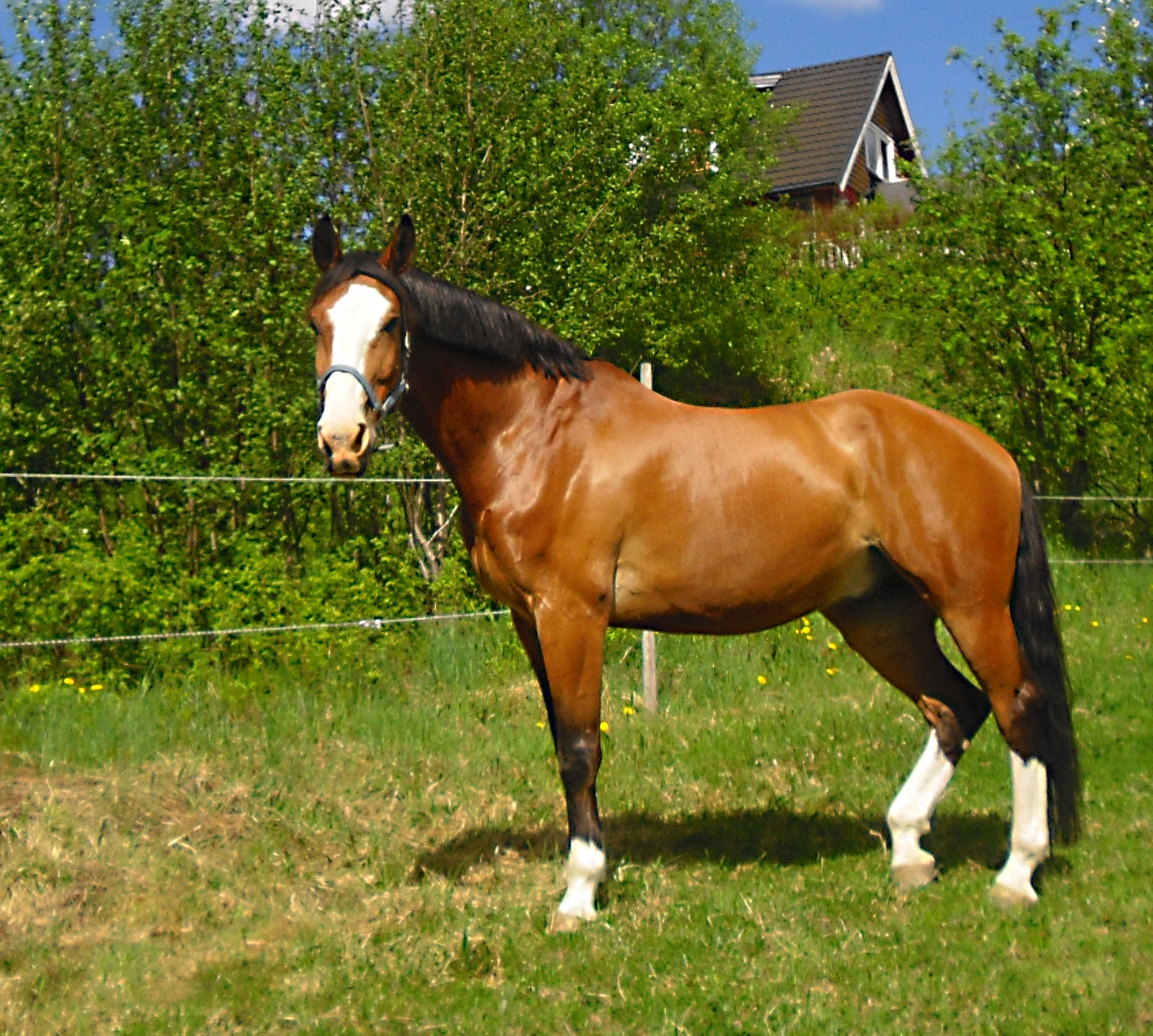
The Holsteiner is characterized by a large and powerful build. With a height at the withers of 160 to 175 cm, it has a short to medium-long, muscular back, a long and strong neck, a broad chest and strong shoulders, and pronounced hindquarters. Its slender, powerful legs and elegant head with expressive eyes give it a majestic appearance.
Coat and Coat Colors
The Holsteiner's coat is relatively short, and the most common colors are bay, gray, and black. Chestnuts are rather rare, and pintos are not provided for in the breeding regulations.
The most common coat colors of the Holsteiner are bay, gray, and black, which gives it a very noble appearance. It is striking that chestnuts are rare and the breeding of pintos is not provided for, meaning that solid-colored horses are the norm. These selected colors enhance the elegant appearance of the Holsteiner, which can often be admired at events and tournaments. The care of its short coat is uncomplicated, which also makes it a popular horse.
Personality & Temperament of the Holsteiner Horse Breed
Intelligence and Willingness to Learn
A Holsteiner is characterized by its intelligence and quick comprehension. This horse breed learns quickly and shows a high willingness to perform. Holsteiners are attentive and ready to work, which makes them ideal sport and leisure partners.
Suitability for Beginners and Children
Due to its calm and patient nature and its balanced temperament, the Holsteiner is definitely suitable for beginners and children. However, it is important that young riders are accompanied by experienced adults to avoid undesirable situations.
Holsteiners are known for their reliability and patience, which makes them a suitable choice for beginners and children. Despite their calm nature, it is still necessary for safety that the horses are kept and trained in a controlled environment. With the right guidance and care, Holsteiners can be ideal partners for riders of all ages.
Health and Longevity of Holsteiners
Average Life Expectancy
The Holsteiner can reach an average age of about 25 to 30 years. This remarkable life expectancy reflects its robust health and good care, making it a long-lived companion.
Common Health Problems
No breed-specific diseases are known in the Holsteiner. However, due to its increased use in sports, diseases of the musculoskeletal system can occur. These are common problems among active sport horses.
The most common health problems in Holsteiners include premature wear and tear of ligaments and tendons, arthritis, joint chips, and kissing spines. Premature wear and tear can result from acute overuse or inadequate training, while arthritis destroys joint cartilage and leads to pain. Joint chips are small bone fragments that move within the joint and can cause pain. Kissing spines occur when the spinous processes of the vertebrae touch each other, leading to severe pain or inflammation.
Holsteiner Horses: Care and Keeping
Species-Appropriate Keeping
Species-appropriate keeping is crucial for the well-being and health of a Holsteiner. In addition to the basic needs of every horse, it needs plenty of space for free movement. Since the Holsteiner is quite large, care should be taken to ensure that its space is sufficient. In addition, fresh air and low dust exposure are important. If the Holsteiner is kept outdoors, good weather protection is essential. The company of other horses is also essential, as the Holsteiner is a social animal.
Species-Appropriate Feeding
A Holsteiner is rather undemanding and has no special requirements for feeding. However, it should always have high-quality roughage and water available. Since Holsteiners are considered somewhat easy keepers, the concentrated feed must always be adapted to the performance requirements.
One of the most important aspects of feeding a Holsteiner is the quality of the roughage, as inferior hay or silage can lead to health problems. Water should always be available in sufficient quantities and clean. Concentrated feed should only be given in accordance with the physical exertion of the animal. Additionally, a balanced supply of minerals and vitamins contributes to maintaining health and performance.

Abilities and Disciplines of Holsteiner Horses
Gaits
The Holsteiner has the gaits walk, trot, and canter. These are swinging, powerful, ground-covering, and graceful, which predisposes this horse breed to top-level sports.
Suitable Disciplines (e.g., Show Jumping, Dressage, Vaulting)
Due to its balanced temperament, beautiful, ground-covering movements, and high willingness to perform, a Holsteiner is suitable for a variety of disciplines. It is one of the most successful breeds in equestrian sports.
Show jumping is undoubtedly the discipline for which the Holsteiner is best known. Thanks to its powerful hindquarters, it has excellent jumping ability and is very successful in both national and international show jumping competitions. A famous Holsteiner in show jumping, for example, was the gelding Meteor under his rider Fritz Thiedemann. He recorded around 150 victories and was even honored with a monument in Kiel. In addition, the Holsteiner, with its elegant and graceful appearance and ground-covering movements, has great talent for dressage and is also predestined as a vaulting horse with its powerful canter. The horse breed is also very popular in eventing. Due to its strength and endurance, it is also suitable for pulling carriages. And because of its excellent character traits and calm temperament, it is also very popular for leisure riding.
Conclusion
The Holsteiner is a horse breed of impressive versatility and elegance, distinguished by its outstanding willingness to perform and its balanced temperament. With origins in medieval Schleswig-Holstein, this warmblood breed has developed into a globally esteemed and successful sport horse. Holsteiners are characterized by their athletic build, intelligent and patient character traits, and their suitability for a variety of disciplines - be it in show jumping, dressage, or as a reliable leisure horse. This horse breed is truly a reliable partner and favorite of many horse lovers around the globe.
Questions about the Holsteiner horse
1. Are Holsteiner horses suitable for beginners?
Holsteiner horses can be suitable for beginners if they are well-trained and of a calm disposition. Their willingness to learn and reliability make them good partners, especially for riders interested in dressage and jumping. However, their temperament can sometimes be demanding, so it is important for beginners to be supported by an experienced trainer.
2. Is the Holsteiner a thoroughbred?
The Holsteiner is not a thoroughbred, but a warmblood. This breed is known for its versatility and is mainly used in show jumping and dressage. Warmbloods are characterized by a combination of strength and endurance, which distinguishes them from purebred thoroughbreds.
3. What colors do Holsteiner horses have?
Holsteiner horses come in various colors, with bay, black, and gray being the most common. Chestnuts are rarer among Holsteiners. The variety of colors contributes to the attractiveness of this breed.
4. Are Holsteiners good show jumpers?
Yes, Holsteiners are excellent show jumpers and are among the best show jumping breeds in the world. Their powerful build, coupled with excellent technique and pronounced jumping talent, make them particularly successful in the show jumping arena. Many international show jumpers prefer Holsteiners due to their performance and reliability.
5. How much does a Holsteiner cost on average?
The price of a Holsteiner can vary greatly, depending on age, training, and lineage, but on average it is between 10,000 and 30,000 Euros. Horses with special successes in sports or from renowned breeding lines can be significantly more expensive. A top horse can even cost several hundred thousand Euros.
6. Which horse breed is very people-oriented?
Horse breeds such as the American Quarter Horse or the Haflinger are known to be very people-oriented. These horses often develop a close bond with their owners and are known for their friendly and good-natured disposition. Icelandic horses are also considered particularly people-friendly.
7. How long do Holsteiner horses live?
Holsteiner horses have a life expectancy of about 20 to 30 years. With good care, a balanced diet, and regular veterinary attention, they can lead a healthy and long life. Their robust constitution also contributes to their longevity.
8. How much does a Holsteiner foal cost?
The price for a Holsteiner foal can vary greatly, but usually ranges between 5,000 and 15,000 Euros. Factors such as lineage, potential, and breeding success of the parents influence the price. Foals from particularly renowned lines or with promising potential for sports can be significantly more expensive.
9. Are Holsteiner horses robust?
Holsteiner horses are known for their robustness and resilience. Their strong build and good health make them long-lived and resilient horses. These characteristics contribute to their appreciation in sports and leisure alike.
10. What is the most expensive horse breed in the world?
The most expensive horse breed in the world is often the English Thoroughbred, especially those used as racehorses. Top horses of this breed can cost several million Euros. Certain warmblood breeds, such as the Hanoverian or Holsteiner, can also fetch very high prices, especially if they have an outstanding lineage and sporting successes.
11. What characterizes the Holsteiner?
The Holsteiner is characterized by its athletic build, outstanding jumping abilities, and versatility in sports. In addition, Holsteiners are known for their good character, willingness to perform, and strong nerves. These qualities make them sought-after horses in international equestrian sports.
12. How much do Holsteiner horses weigh?
Holsteiner horses typically weigh between 500 and 700 kg, depending on their size and build. Their powerful musculature and robust build contribute to their weight, making them strong and powerful.
13. What is the largest horse breed in the world?
The largest horse breed in the world is the Shire Horse. These horses can reach a shoulder height of up to 200 cm and are known for their immense strength and impressive size. Shire Horses are traditionally used for heavy draft work.
14. What is the oldest horse breed in the world?
The oldest known horse breed in the world is the Arabian thoroughbred. This breed has a history spanning thousands of years and has influenced many modern horse breeds. Arabians are known for their endurance, beauty, and intelligence.
15. Is Holsteiner a horse breed?
Yes, Holsteiner is a specific horse breed that originated in the Holstein region of Germany. This breed has made a name for itself worldwide due to its excellent qualities in show jumping and eventing. Holsteiners are selectively bred to combine the best athletic and character traits.
Sources:
- Commons: Holsteiner
- Wikipedia: Holsteiner
- News on the topic: Holsteiner
- Breeding association in Germany
- Holsteiner Horse
- The Friesian Horse Society, a North American registry for Friesians, crosses, and Arabo-Friesians
- Thomas Nissen: Das Kloster Uetersen und die Holsteiner Pferdezucht In: Bauernblatt Schleswig-Holstein und Hamburg: Mitteilungsblatt der Bauernverbände Schleswig-Holstein und Hamburg, Organ der Landwirtschaftskammer Schleswig-Holstein (Rendsburg: Verlag Bauernblatt für Schleswig-Holstein 57/153 (2003))
Other horse breeds:
Editorial Guidelines of the Horse Vitality Company
At Horse Vitality Company, we create every post according to strict quality standards, relying on reputable sources and scientific research. Our editors are proven experts in equine health and provide you with well-founded, trustworthy information.
Expertise and Quality Assurance
- Qualified Authors: Our editors possess extensive expertise in equine health and animal care.
- Double-Check: Every article is additionally reviewed by a second expert to ensure accuracy and relevance.
Sources and Transparency
- Reputable Sources: We only use trustworthy sources and scientific studies to substantiate the content.
- Disclosure: We disclose potential conflicts of interest and ensure transparency.
Reader-Friendliness and Actuality
- Reader-Friendly Preparation: Our content is continuously optimized to make it as understandable and accessible as possible.
- Actuality: We regularly review our articles and update them as needed to ensure they are always up-to-date.
Interaction and Feedback
- Reader-Oriented: Our goal is to provide you with initial guidance. For individual health or care questions, we recommend consulting a veterinarian or animal naturopath.
- Feedback Option: We invite our readers to provide feedback and ask questions. Your suggestions help us continuously improve our content and tailor it to your needs.
These guidelines ensure that the content of Horse Vitality Company consistently meets the highest standards of expertise, authority, and trustworthiness.


