

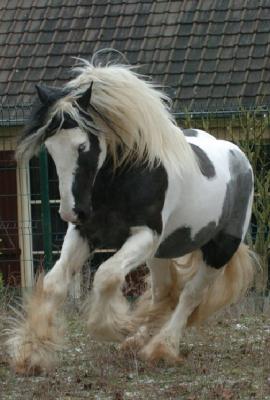
The Tinker: Gentle Powerhouse
The Tinker, also known as the Gypsy Horse or Gypsy Vanner, stands out worldwide with its spotted coat and gentle character. This horse breed impresses not only in sports and leisure activities but also with its robust nature. As you will learn in this blog post, the Tinker is a loyal companion with a fascinating history and versatile uses. Dive into the world of Tinkers and discover everything you need to know about the origin, appearance, and character of this fascinating horse breed.

Profile: Tinker
| Origin | Ireland and Great Britain |
| Main Breeding Area | Germany |
| Distribution | Throughout Europe |
| Bred since | around 1900 |
| Life Expectancy | 25 - 30 years |
| Size | 130 to 160 cm |
| Weight | 450 - 800 kg |
| Color | Predominantly Piebald/Skewbald |
| Type | Warmblood |
| Character | Balanced, people-oriented, intelligent, willing to work, friendly |
| Body |
Striking long mane and tail and feathering on the legs, robust build, strong head, powerful neck, characteristic beard |
| Suitable for | Leisure, Therapy riding, Driving sports |
| Keeping and Care |
Plenty of exercise and movement, appropriate feeding to prevent diseases such as mud fever, laminitis, etc. |
Origin of the Tinker
History and Development
The Tinker, also known as the Gypsy Horse or Gypsy Vanner, originally comes from the travelling communities of Great Britain and Ireland. These robust and enduring horses were bred to meet the demands of the Romani and Irish Travellers. Various breeds such as the Shire Horse, the Clydesdale, and the Welsh Cob were combined in breeding to achieve the desired characteristics.
Breeding Association and Registration
It wasn't until the 1990s that the first official breeding association for Tinkers, the Irish Cob Society (ICS), was founded. This organization advocated for the recognition and standardization of the breed.
The founding of the ICS was a significant step for the official recognition of Tinkers as an independent breed. By registering with the ICS, you can ensure that your Tinker meets the breed standards and has a documented lineage. This registration is important not only for the studbook but also for monitoring the health status and genetic diversity of the horses. The ICS also provides support and resources for owners and breeders to promote the welfare and preservation of the breed.
Appearance of the Tinker
Build and Coat
The Tinker has a strong and compact build with a broad chest and powerful legs. One of its most striking features is the characteristic spotted coat, which usually comes in piebald or skewbald patterns. Greys, blacks, and browns are also possible. The long mane and tail and abundant feathering give the Tinker its unmistakable appearance.
Size and Weight
Tinkers come in almost all sizes, from smaller ponies to larger horses. On average, a Tinker reaches a height at the withers of about 135 to 160 cm and a weight between 450 and 700 kg.
However, since there is great variability within the breed, you will find both smaller, more delicate specimens and larger, stronger Tinkers. This versatility makes them a popular choice for many different riders and drivers.
Special Features
In addition to the characteristic coat pattern, the Tinker is known for its large, dark or blue eyes and a slight Roman nose. In winter, the Tinker can even develop a beard, which is hardly visible in summer.
These unique features not only give the Tinker a striking appearance but also make it an interesting and lovable breed for horse enthusiasts. Its abundant feathering and powerful long mane and tail are equally remarkable and make it a real eye-catcher.
Character of the Tinker
Friendliness and Loyalty
Tinkers are known for their friendly nature and pronounced loyalty. These horses are very people-oriented and are interested in a close bond with their owners. Their gentle nature makes them particularly popular with families and beginners.
Intelligence and Willingness to Work
Another remarkable characteristic of the Tinker is its intelligence and high willingness to work. These horses learn quickly and are always motivated to master new tasks. They are excellent for various disciplines because they have a quick grasp.
Tinkers are not only intelligent but also very willing to work, which makes them excellent all-rounders. They show a high readiness to learn and are easy to train, making them ideal for use as leisure or therapy horses. Your Tinker horses will shine with their curiosity and motivation when they tackle new challenges.
Patience and Balance
The patience and balanced temperament of Tinkers are further striking characteristics of this breed. These horses always keep a cool head and are not easily rattled. These abilities make them particularly suitable for handling children and inexperienced riders.
Thanks to their patience and balance, Tinkers are ideal for stressful or unpredictable situations where other horses might react nervously. They offer you a reliable and calming presence, which allows you to remain calm even in challenging times. These qualities make them a stable choice for many different equestrian sports and leisure activities.

Keeping and Care of the Tinker
Keeping in an Open Stable
Due to its robust and resilient character, the Tinker is ideally suited for keeping in an open stable. Its long and dense coat protects it from various weather conditions, which is why it should be kept in well-ventilated but wind and moisture-protected areas. Dry, mud-free ground is important to prevent diseases such as mud fever. The Tinker should also have regular contact with other horses, as it is a very sociable animal.
Feeding and Nutrition
A Tinker is considered easy to keep and tends to gain weight quickly. The basis of its diet should consist of sufficient good quality roughage. Concentrates should only be fed if necessary to avoid obesity and associated diseases. A good mineral feed helps to meet the horse's energy requirements and provide it with all necessary vitamins and minerals.
Since Tinkers are good feed converters, a combination of roughage and a mineral feed is often sufficient to keep them healthy. Always keep an eye on your Tinker's weight and adjust its feeding accordingly. Lack of exercise and excessive energy intake can quickly lead to health problems.
Health and Diseases
Despite their robustness, Tinkers are prone to certain breed-specific diseases. Laminitis, mud fever, and sweet itch are the most common health problems that can occur in these horses. Regular care and attention are required to detect and treat these diseases in time. Especially the feathering should be regularly checked and cared for.
Laminitis, a painful inflammation of the hoof laminae, can be caused by a diet too rich in starch and sugar. Mud fever, a skin disease, often occurs in horses with heavy feathering and can be exacerbated by poor living conditions. Sweet itch is an allergic skin reaction triggered by the saliva of certain insects. These clinical pictures show how important careful care and monitoring of your Tinker's health status are.
Gaits and Movements of the Tinker
Walk, Trot, and Canter
The Tinker has three natural gaits: walk, trot, and canter. These gaits are powerful and sweeping, making it a pleasant riding horse. The walk is even and calm, the trot energetic, and the canter gentle and rhythmic. Through these movements, the Tinker shows its impressive ability to move confidently both over long distances and on tighter routes.
Peculiarities of the Gaits
The Tinker is characterized by special movement patterns that distinguish it from other horse breeds. Particularly striking is its powerful and sweeping stride, which is evident in all three basic gaits. These characteristics make the Tinker not only an excellent leisure horse but also a popular partner in driving sports and therapy.
Another special aspect of the Tinker's gaits is its natural carrying capacity, which is supported by its powerful build and strong legs. This allows it to move safely even on uneven terrain and to move securely even in difficult situations. At the same time, it is important to note that despite its robust appearance, the Tinker is not a weight carrier. Due to its often weakly muscled back, care should be taken with the load to avoid long-term damage.
Disciplines and Uses of the Tinker
Driving Sports and Leisure Riding
The Tinker was originally bred for pulling heavy wagons and is therefore excellently suited for driving sports. Its friendly, patient, and balanced character also makes it the perfect partner for leisure riding. If you are looking for a reliable companion who enjoys roaming through forests and fields with you, the Tinker is an excellent choice.
Therapy Horse and Other Uses
Thanks to its positive characteristics, the Tinker is also often used as a therapy and companion horse. Its loyal, people-oriented, and intelligent nature makes it an ideal therapy partner, capable of building a close bond and responding sensitively to people's needs.
The Tinker's suitability as a therapy horse is remarkable. It can be used in various therapeutic settings, be it in disability therapy or equine-assisted therapy. Its patience and balance are particularly advantageous when working with physically or emotionally impaired people. This also makes it a valuable companion in social projects and educational institutions.
Price and Purchase of a Tinker
Average Price
The price for a Tinker can vary greatly. On average, you can expect to pay between 2000 and 7000 Euros. However, the exact price largely depends on various factors, which will be discussed in more detail below.
Factors Influencing the Price
When buying a Tinker, several important factors can influence the price:
- Age
- Training level
- Pedigree
- Health status
Inform yourself well beforehand, as this is the only way to make a good purchasing decision.
A younger horse is often more expensive than an older horse, especially if it is already well-trained. The training level is also crucial: a well-trained Tinker generally costs more. Pedigree plays an essential role, especially if the parents are well-known and successful breeding animals. The horse's health status is another important factor. A Tinker with health problems will probably be cheaper but can incur higher long-term costs.
Conclusion
The Tinker, known for its striking piebald/skewbald markings and gentle character, is a versatile partner for sport and leisure. Originally bred by the Romani and Irish Travellers, it brings robust and friendly qualities. Its powerful body, abundant mane, and gentle character make it unique. Tinkers are patient, intelligent, and particularly suitable for children and beginners. With proper keeping and care, you can find a loyal and lifelong companion in a Tinker.
Questions about the Tinker Horse Breed
1. Is a Tinker difficult to ride?
Tinkers are generally not difficult to ride and are often valued for their calm and placid temperament. They are known for their patience and serenity, which makes them particularly suitable for less experienced riders. Nevertheless, every horse can have individual differences, and it is important that the rider has the right training and experience.
2. Are Tinkers suitable for beginners?
Yes, Tinkers are well-suited for beginners due to their balanced temperament and placidity. They are patient and forgive small mistakes, making them ideal schoolmasters. Their robustness and friendliness also contribute to them often being recommended for beginner riders.
3. Is a Tinker a horse or a pony?
Tinkers can be classified as both a horse and a pony depending on their size. However, they usually exceed the size category of ponies and are mostly considered horses. Their powerful build and strong physique are remarkable regardless of the exact classification.
4. How much weight can a Tinker carry?
Tinkers are very robust and powerful horses that can easily carry a weight of up to 90 kg or more. Their strong musculature and powerful legs enable them to support heavier riders. However, it is always important to pay attention to the individual condition and health of the horse.
5. What should one know about Tinkers?
Tinkers are known for their impressive feathering, including abundant manes and tails, as well as thick fetlock hair. They are very social and friendly horses that get along well with people and other animals. Their robust nature and calm temperament make them versatile and reliable leisure horses.
6. How long can a Tinker live?
With good care and health, a Tinker can live for an average of 25 to 30 years. Their longevity depends on factors such as diet, exercise, veterinary care, and general maintenance. Species-appropriate husbandry and regular exercise contribute significantly to their health and longevity.
7. Can a 90 kg person ride a Tinker?
Yes, a Tinker can easily carry a rider weighing 90 kg. These horses are strong and have powerful muscles, which makes them ideal carriers for heavier riders. Nevertheless, the rider's weight should always be in proportion to the horse's size and condition.
8. Are Tinkers suitable for children?
Tinkers are well-suited for children due to their friendly and patient nature. They are often calm and placid, which makes them ideal horses for young riders. Their gentle nature and robustness make them reliable partners when interacting with children.
9. Are Tinkers stubborn?
Tinkers can sometimes be perceived as stubborn, which is often related to their intelligent and strong-willed nature. However, they are generally very willing to learn and respond well to consistent and patient training. With the right guidance and positive reinforcement, any stubbornness can be managed well.
10. Do Tinkers have a lot of impulsion?
Tinkers usually have less impulsion compared to other sportier horse breeds, as they are naturally more powerful and calm. Their movement is often more relaxed and even, which makes them ideal for leisurely rides and recreational sports. Nevertheless, they can also perform well in suitable disciplines, such as dressage.
11. Are Tinkers robust?
Yes, Tinkers are very robust and hardy horses. Their powerful build and resilience to adverse weather conditions make them particularly robust. They are known for their good health and their ability to thrive even under simple keeping conditions.
12. What saddle fits a Tinker?
The best saddle for a Tinker is one that is adapted to the broad and powerful build of these horses. A well-fitting saddle with a wide gullet and sufficient padding is important to ensure comfort for the horse. It may also be advisable to consult a saddler to select the optimal saddle for the horse.
13. What horse breed is Pippi Longstocking's horse?
Pippi Longstocking's horse is a grey named "Kleiner Onkel" (Little Uncle) in the German translations of Astrid Lindgren's books. In the original books and films, it is a white horse with black spots, often depicted as a Shetland pony. Little Uncle is known for his patient and calm nature.
14. Are Tinkers susceptible to diseases?
Tinkers are generally robust and less susceptible to diseases than many other horse breeds. However, they do have a predisposition to certain skin problems such as mud fever, which can be exacerbated by their dense feathering and wet weather. Regular care and a good housing environment can help minimize such health problems.
Sources:
- Commons: Tinker
- Wikipedia: Tinker
- News on the topic: Tinker
- Breed portrait Tinker of the FN (PDF)
- Website of the Irish breeding association ISC, owner of the Irish-Cob studbook
- Website of the Tinker Horse And Irish Cob Society Germany e.V. (THAICS)
- Website of the Austrian Breeding Association for Ponies, Small Horses and Special Breeds
- Website of the Special Color Switzerland Association
- Christiane Slawik and Heike Lauger: Tinker Ponys. Irlands coole Schecken. Ein Rasseportrait. Cadmos Verlag, ISBN 3-86127-352-7
Other horse breeds:
Editorial guidelines of the Horse Vitality Company
At Horse Vitality Company, we create every post according to strict quality standards and rely on reputable sources and scientific research. Our editors are proven experts in equine health and offer you well-founded, trustworthy information.
Expertise and quality assurance
- Qualified authors: Our editors have extensive expertise in equine health and animal care.
- Double-check: Every article is additionally reviewed by a second expert to ensure accuracy and relevance.
Sources and transparency
- Reputable sources: We only use trustworthy sources and scientific studies to substantiate the content.
- Disclosure: We disclose potential conflicts of interest and ensure transparency.
Reader-friendliness and topicality
- Reader-friendly presentation: Our content is continuously optimized to make it as understandable and accessible as possible.
- Timeliness: We regularly review and update our articles as needed to ensure they are always up to date.
Interaction and feedback
- Reader orientation: Our goal is to provide you with initial guidance. For individual health or care questions, we recommend consulting a veterinarian or animal naturopath.
- Feedback option: We invite our readers to provide feedback and ask questions. Your suggestions help us to continuously improve our content and tailor it to your needs.
These guidelines ensure that the content of the Horse Vitality Company always meets the highest standards of expertise, authority, and trustworthiness.


