

Everything you need to know about the Oldenburg horse breed
The Oldenburg horse breed is one of the most successful and impressive in the world, thanks to its special physical and temperamental characteristics. Originally from northern Germany, the Oldenburg has evolved over the centuries from a strong draft and carriage horse into an elegant and athletic sport horse. With a balanced temperament, high intelligence, and remarkable willingness to perform, these horses are excellently suited for various disciplines such as dressage, show jumping, and eventing. Oldenburgs are characterized by a strong build, expansive movements, and their good-natured disposition. Despite their wide range of uses, potential health risks in competitive sports, particularly ligament and tendon injuries, should be kept in mind.

Profile: Oldenburg
| Origin | Germany |
| Main breeding area | Oldenburg |
| Distribution | Throughout Europe |
| Bred since | 17th century |
| Life expectancy | 25 - 30 years |
| Size | 165 to 180 cm |
| Weight | 500 - 800 kg |
| Color | All coat colors |
| Type | Warmblood |
| Character | Intelligent, willing to perform, good-natured, balanced |
| Build |
Large-framed, powerful and muscular build; Broad chest, well-developed hindquarters; |
| Suitable for | Dressage, show jumping, eventing, driving, leisure |
| Keeping and care |
Plenty of turnout space and regular exercise; No special care needed |
History of the Oldenburg
Origin in 17th Century Germany
The history of the Oldenburg begins in the 17th century in Northern Germany, specifically in Oldenburg. The Oldenburg horse of that time was a popular draft, work, and carriage horse with a powerful build, which enabled its versatile use. Count Anton Günther of Oldenburg and Delmenhorst laid the foundation for the breed by breeding lighter and more elegant horses without losing their strength.
Development of the breed
The breeding of the Oldenburg has continuously evolved over the centuries. In the 19th century, important developments took place, such as the introduction of stallion licensing in 1820 and the stud book in 1861. To increase elegance and athleticism, crosses with Hanoverians, Holsteiners, and Thoroughbreds were made in the 20th century. This led to the modern appearance of the breed, which is now considered one of the most successful sport horses in the world.
Through targeted crosses with other well-known breeds, the Oldenburg was further developed into an athletic and elegant sport horse. In the 1950s, as the demand for work and carriage horses decreased, the focus of breeding shifted to creating versatile and high-performing horses for sport. The introduction of modern breeding methods and strict standards has contributed to the Oldenburg's success in various disciplines today.
Important milestones in the history of the breed
A significant milestone in the history of the Oldenburg was the introduction of the stallion register in 1820 and the stud book in 1861. The Oldenburg Horse Breeders' Association was founded in 1923, which contributed to the systematization of breeding. In the 1950s, breeding was further refined to reorient the Oldenburg for the emerging demand in sports. In addition, the "Springpferdezuchtverband Oldenburger International e.V." (Show Jumping Horse Breeding Association Oldenburg International) was founded in 2001 to specialize in breeding successful show jumpers.
The introduction of the stallion licensing system in 1820 and the creation of the stud book in 1861 were crucial for the organized breeding of the Oldenburg. These steps enabled breeders to work more targeted and efficiently. With the founding of the "Verband der Züchter des Oldenburger Pferdes e.V." (Association of Breeders of the Oldenburg Horse) in 1923 and the merger of the two former horse breeding associations, breeding was further professionalized. The numerous breeding successes of the 1950s, as well as the secession and later integration of the show jumping breeding association, mark further important events in the history of this impressive breed.
Physical characteristics of an Oldenburg
Build and size
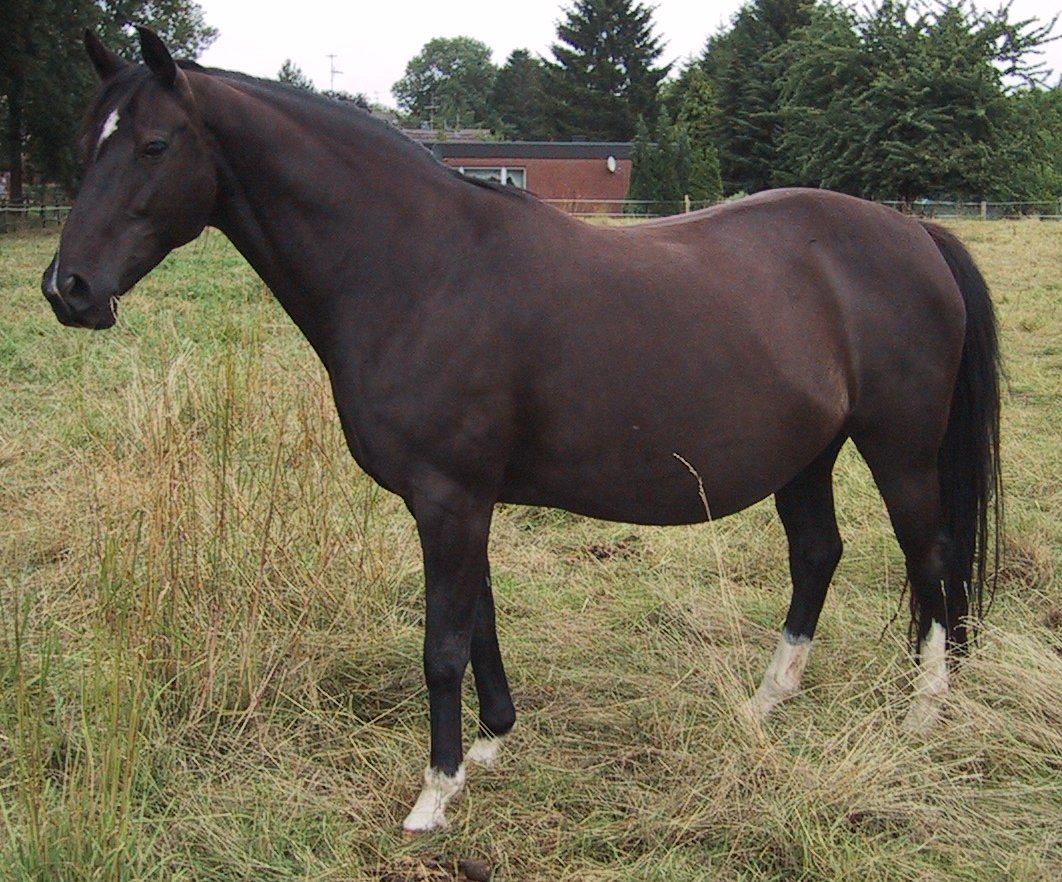
The Oldenburg has a large-framed and powerful build with a height at the withers of 165 – 180 cm. Typical features include a short to medium-long, muscular back, a long, powerful neck, a broad chest, sloping shoulders, and well-developed hindquarters. Thanks to the strong infusion of Thoroughbred blood, a rather high tail set is often found.
Coat colors and patterns
All coat colors exist in the Oldenburg breed. They most commonly appear as browns, blacks, chestnuts, or greys. Pintos are rather rare. White markings, however, unlike some other breeds, are permitted in breeding and are not uncommon.
The variety of coat colors in Oldenburg horses shows that the breed is not limited to a specific color. This makes them particularly attractive to breeders who value color diversity. White markings often give these horses a particularly noble appearance and are another reason why this breed is so popular.
Head and facial features
The Oldenburg's head is elegant and characterized by expressive eyes, medium-long ears, and a broad forehead. Previously, a Roman nose was more common, but today the nasal line is usually straight.
The expressive eyes and broad forehead give the Oldenburg an intelligent and friendly appearance. These features are complemented by the medium-long ears, which give the horse a harmonious and noble overall impression. Today's Oldenburgs have a straight nasal line, which distinguishes them from their Roman-nosed ancestors and gives them a modern, athletic appearance.
Oldenburg Horses: Temperament and Character
Intelligence and Trainability
The Oldenburg is known for its high intelligence and excellent trainability. This horse breed has a quick grasp and learns very quickly. As a result, Oldenburgs are able to understand and implement complex exercises and commands rapidly.
Friendly and people-oriented nature
A significant characteristic of the Oldenburg is its friendly and people-oriented nature. These horses strive for a close bond with their owner and are eager to please. Due to these qualities, Oldenburgs are well-suited as riding horses for many equestrian disciplines.
An Oldenburg displays great good nature and is generally very sociable. These horses enjoy human company and quickly develop a deep bond with their owners. This makes them particularly interesting for riders who want to build a close partnership with their horse. Beginners and children, in particular, benefit from the calm and good-natured temperament of this breed.
Balanced temperament
Despite their high willingness to perform, Oldenburgs possess a balanced temperament. They are typically calm and composed, making them reliable partners in equestrian sports. This characteristic also makes Oldenburgs attractive to less experienced riders.
The calm and relaxed nature of an Oldenburg contributes significantly to its reputation as safe and reliable. Even in stressful or new situations, they usually remain composed and show remarkable composure. This balance helps not only in training and competition but also in daily interactions, as it offers a high degree of security for riders and owners.
Suitability of the Oldenburg horse breed for riders
Suitable for beginners and children
Thanks to its good-natured and balanced temperament, the Oldenburg can be suitable for beginners and children. Its intelligence and composure contribute to it being a reliable partner. Nevertheless, the individual character of the horse should always be considered to ensure its suitability for inexperienced riders.
Importance of individual temperament
The individual character and disposition of a horse can vary greatly and play a crucial role in its suitability for different riders.
While the Oldenburg is generally known for its good nature and composure, it is essential to consider the individual temperament of a horse. Not every Oldenburg horse will automatically be suitable for beginners or children. A close bond between rider and horse and a careful selection process are crucial to ensure that both partners harmonize and the rider's training is successful.
Considerations for rider's height and experience
The rider's height and experience must also be considered before choosing an Oldenburg. A suitable ratio between the two is important for a successful partnership.
Due to the often large-framed build of the Oldenburg, which can reach a height at the withers of 165 – 180 cm, it may not always be the ideal choice for small children. It is important that the rider has sufficient experience to handle the size and strength of such a horse. A harmonious size relationship between rider and horse ensures that communication and aids can be given effectively and safely.
Health and Longevity of Oldenburg Horses
Average life expectancy
An Oldenburg can live between 25 and 30 years. This impressive life expectancy is due to its robust constitution and careful breeding, which aims to produce healthy horses. With proper care and keeping, Oldenburgs can enjoy a long and fulfilling life.
Common health problems
Although Oldenburgs are generally considered a robust breed, due to their frequent use in competitive sports, they may be prone to problems with their musculoskeletal system. These include conditions such as ligament and tendon injuries, osteoarthritis, and kissing spines, which can be caused by overexertion, unsuitable ground, or poor training.
Ligament and tendon injuries frequently occur when the horse is overused or works on unsuitable ground. Osteoarthritis is a degenerative joint disease that can cause severe pain and lameness. Kissing spines refers to the approximation or rubbing of the spinous processes of the vertebrae, which can also lead to significant discomfort.
Importance of regular veterinary care
Regular veterinary care is essential for Oldenburgs to maintain their health and performance. Routine examinations help to identify potential problems early and treat them promptly before they can develop into serious health issues.
Through regular veterinary examinations, conditions such as osteoarthritis or tendon damage can be detected and treated at an early stage. The correct adjustment of training and the care of the musculoskeletal system also play a decisive role. An experienced veterinarian can also provide valuable advice on optimal feeding and keeping, which also contributes to a long and healthy life.
Care and Keeping of Oldenburgs
Environment and housing
An Oldenburg horse requires species-appropriate keeping that meets its needs. Due to its size and high willingness to perform, it needs a lot of free space. An open stable with a large and dry shelter is ideal. If this type of keeping is not possible, a stall with daily several hours of turnout in a large paddock or pasture can also be an option. Important is that the horse is never kept alone, as it is very social and needs the company of other horses.
Nutritional needs and feeding habits
The basis of an Oldenburg's diet should consist of high-quality roughage such as hay or haylage. Excessive energy intake should be avoided. Concentrates should only be supplemented if necessary. In most cases, it is sufficient to provide the horse with enough roughage combined with a good mineral feed to meet its energy requirements and supply it with all necessary vitamins and minerals.
Oldenburg horses do not have special demands regarding their feeding. The main focus should be on not providing them with too much energy, as this can lead to health problems. Concentrates are usually only necessary for particularly high exertion. A sufficient supply of high-quality roughage and regular monitoring of feed quality are crucial to maintain the horse's health and performance in the long term. Mineral feed supplements the nutrient profile and ensures a balanced supply.
Socialization and exercise needs
An Oldenburg is a very social horse that needs the company of other horses. Isolated keeping is absolutely unsuitable. Regular exercise and activity are also essential to ensure the horse's physical and mental health. Daily pasture access combined with athletic activity is ideal to meet its high performance demands.
Both socialization and exercise needs are crucial for the health and well-being of the Oldenburg. Horses of this breed should be regularly kept in a herd or at least in the company of other horses to prevent stress and loneliness. Exercise should be ensured not only through outdoor access but also through targeted training and games. This helps to prevent obesity and associated health problems and keeps the horse physically and mentally fit.

Oldenburg Horses: Uses and Disciplines
Dressage and show jumping
Due to their elegant, athletic appearance and their expressive and expansive movements, Oldenburgers are often very successful in dressage. A famous Oldenburger was the stallion Donnerhall, who achieved over 300 victories in various dressage competitions, including two team world championship titles. Oldenburgers also excel in show jumping thanks to their powerful hindquarters and great jumping ability. They are versatile and very popular in competitions.
Versatility and Cross-Country
With their athletic build and high willingness to perform, Oldenburgers are ideally suited for eventing and cross-country riding. They are versatile and can excel in many equestrian disciplines, especially in challenges that require technical skill and endurance.
In eventing, horses must pass various tests, including dressage, show jumping, and cross-country riding. Thanks to their intelligence and balanced temperament, Oldenburgers repeatedly demonstrate their adaptability and performance strength here. These disciplines demand a high degree of trust and cooperation between rider and horse, qualities that the Oldenburger excels at due to its people-oriented and good-natured character.
Other Disciplines and Activities
Oldenburg horses are also very popular outside of classic competition disciplines. They are frequently used in leisure and trail riding and also excel in driving sports.
In leisure riding, riders benefit from the calm and good-natured temperament of Oldenburgers, which are suitable for both beginners and experienced riders. In driving sports, the Oldenburger demonstrates its versatility and strength as a reliable carriage and working horse. Due to their friendly and people-oriented nature, Oldenburgers are also ideal companions for therapeutic riding and other equine-assisted activities.
Conclusion
The Oldenburger is an impressive horse breed from northern Germany, known for its elegant appearance, great intelligence, and remarkable willingness to perform. This versatile warmblood has been bred since the 17th century, originally as a draft, work, and carriage horse, and has evolved over time into a popular sport horse. With its powerful build, balanced temperament, and outstanding movement characteristics, the Oldenburger is excellently suited for disciplines such as dressage, show jumping, and eventing.


